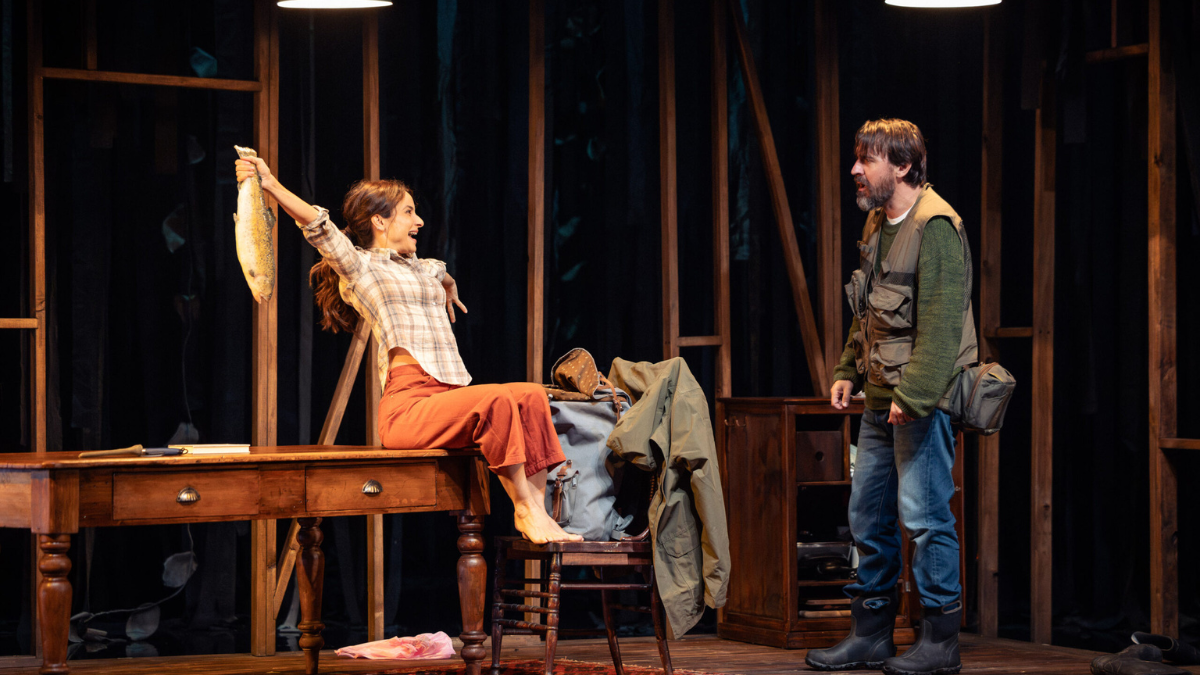
I recently received a free ticket to watch The River, at the Opera House, courtesy of my friend working there. And while the initial description of the play outlined a relatively simplistic tale of a fisherman inviting a woman to his family’s cabin, the reality of the story felt much more sinister.
As a prior warning, I will go ahead and say that I definitely recommend this play to anyone who enjoys a good mindfuck. The play will really get you to think and by the end, you will have more questions than answers. I know I was thoroughly entertained. However, in order to provide an accurate review, I will have to describe the contents of the play in detail.
If you are intending to watch it yourself, or you have tickets to see it, you may want to give this review a miss until after. The play’s main attraction is the mystery and suspense it builds. And if you don’t want to be spoiled, please stop reading now. And be aware the play is only being shown at The Opera House until this Saturday.
The Basic Premise
The story starts off with a woman singing to herself, when she sees something that shocks her. She desperately tries to get the attention of her companion, who is so preoccupied with finding his gear, he refuses to focus on her. He claims he has already seen what she is seeing and it is revealed she has been so entranced by a sunset.
In an attempt to convince the man that no two sunsets are the same, she forces him to describe what she is seeing while she covers his eyes. Without a single misstep, he describes what she is seeing so expertly that she is taken aback. The intimate moment is then interrupted by his attempts to get her to go fishing with him.
This is our first clue that the scene we are witnessing has happened before. Because as soon as the couple leaves to go fishing, the scene shifts to one of horror and rage as he desperately tries to get through to the police to report a missing woman. He is trapped in darkness with lightning underscoring his every communication.
And when the audience has been fully immersed in the horror of the scene, the atmosphere immediately relaxes and the man’s companion re-enters with a smile on her face and a bounce in her step.
Only this is not the same woman.
A Warped Reality
As the play progresses, you see the same scene and the same conversation play out across multiple women. And at first, there is no clear indication that the character has changed. One woman leaves the stage and another enters, but the conversation continues as though no interruption had taken place.
But as you progress, the story gets progressively more unsettling. Who is the woman in the sketch with her face scratched out? If the red dress is left remaining in the closet, why did the subsequent scene show the woman in the red dress walking out while still wearing it?
Because at first, you view two women. One older and one younger. And it would be easy to assume that the younger woman is the man’s first love. She is the one he made a passionate confession to. She is the one he tried to stop from leaving. And she is the one who sits by the edge of the stage, in her red dress, while the older woman asks who the red dress belonged to?
And why is it that regardless of which woman is on stage, the man seems to be reliving the same conversation, over and over again? Both women see the bird slam into the glass window and both women leave the bird outside. And yet, both times, the man states this has happened before.
Are we viewing the story through the man’s distorted sense of reality? Is he simply fracturing under the strain of losing his true love? And is he now attempting to recreate that connection by living the same story with a multitude of women? And if so, is the frequent changing of actresses an indication that he is simply remembering? Because it seems as though time is shifting backwards and forwards.
The Women Are The Only Actors In The Scene, The Man Is Simply Reacting
While the women are vibrant and full of spirit, the man is stuck repeating a script. He wants to take her out fishing, he loses her along the way, he panics and then she returns to the cabin with a fish. Both women outright refuse to go fishing until the man forces the issue. And while the women have moments of feeling and passion, the man is stuck reliving a moment that has already passed.
The only scene in which he is the focal point, and genuinely reveals himself, is while he is recounting the tale of his first fish. And when he tells the tale of losing it, he shows genuine emotion. He has a reaction that far supersedes the severity of the situation. He is distraught and so caught in the memory that he almost seems to slip away from the moment.
In every other instance, the women notice something is wrong. When the older woman recounts walking by the river, she tells the tale of seeing a woman her age, standing in the distance, laughing. She is deeply unsettled by the experience. And yet, the man is deflecting her every attempt to communicate her genuine fear.
And when she finally points out the gold necklace in the soap dish and the red dress in the wardrobe, he withdraws and refuses to explain who the items belong to. And when she asks about the framed sketch of the woman with her face scratched out, you see another woman appear on screen.
She is wearing a red dress.
Next, it is her turn to engage with the man. And this time, you see him sketching her. And you believe she must be the subject of the drawing. She must be the original lover. The one he is trying to find in the women who follow her. And yet, he isn’t looking at her when he sketches.
He is looking at her reflection. This is our first hint that she is not the first to visit the cabin. In fact, when she later confronts the man about the sketch of the woman with her face scratched out, we know she must not be the subject. She is recreating a moment that has already passed.
The play ends with the introduction of a third woman and a repetition of the man’s, already twice-repeated, dialogue from the beginning of the play.
The Main Subject Of The Play Is Missing
The eerie atmosphere and unexplained swapping of actresses leaves more questions than answers. But there is also a sense that a character is missing.
You see, neither woman is the man’s original lover. He lost the first woman he brought to the cabin, long before the start of the play. And every woman that appears on stage is only an echo of the woman who is missing from the story.
What happened to her? Why is her dress hanging from the wardrobe? Who is the woman who stood by the river and laughed? And why is she no longer there? Is this simply a breakup gone wrong? Is the man simply someone who could not move on?
But then, what is with the chanting and the candles? This isn’t a story of heartbreak, so much as a story of reality bending and twisting. This is a story of death and the ghosts left behind. While the muse is never shown, her presence is felt in every line. And her absence creates so much pain that the man is unable to acknowledge her very existence.
He is left with echoes of her. Trying the same script, and recreating the same scenes over and over again. With the hope that maybe just once, it’ll stick. But while he may claim to love all three women, he is unable to truly look at them. He shies away from intimacy and when the women go off script, he cannot face them.
Final Thoughts
This review is a little different from my usual style. And I think it comes down to the format of the play. The play does not assume its audience is lacking in intelligence. In fact, the story remains as complex as needed and the audience is left to fill in the gaps on their own.
And as I was sitting in the third row, close enough to see the actor’s eye twitch, I felt as though I was intruding on an intimate moment. I wasn’t simply watching a story made for my entertainment. I was a voyeur to a fractured relationship. And of course, I wasn’t watching the play in between scrolling on my phone.
For the first time in a while, my entire attention was on the story. I had no choice but to focus and think. Because if I allowed my attention to stray, I wouldn’t understand what I was seeing. I would miss a key moment and be hopelessly out of the loop.
And I think the depth and complexity of the story has forced the Creative Writing major, in me, out of hibernation. I felt like I was back at University, asked to watch a play that had not been dumbed down for public consumption, and analyse it until I truly understood it.
And it was thrilling. Watching media that assumes its’ audience is stupid can be very detrimental to our capacity to think critically. I don’t need something dumbed down for me. I need it to be as complex as it needs to be, and I need the writer to trust me to fill in the blanks myself.
The point of media isn’t always to understand. Sometimes the point is to be struck so deeply by what’s missing that you fill in the blanks yourself. Honestly, after the play was over, I spent a good hour analysing it with my friend. I made so many connections to my own past relationships.
And it was fun.






Leave a Reply